History’s simply a chronicle of people entering and exiting variously curated rooms wearing different hats. Queue, cyclically, everything going boom; this book was written after one such schismatic ruction, therefore one is forgiven the dubbing of literature written in, particularly that, war’s wake “post-apocalyptic”.
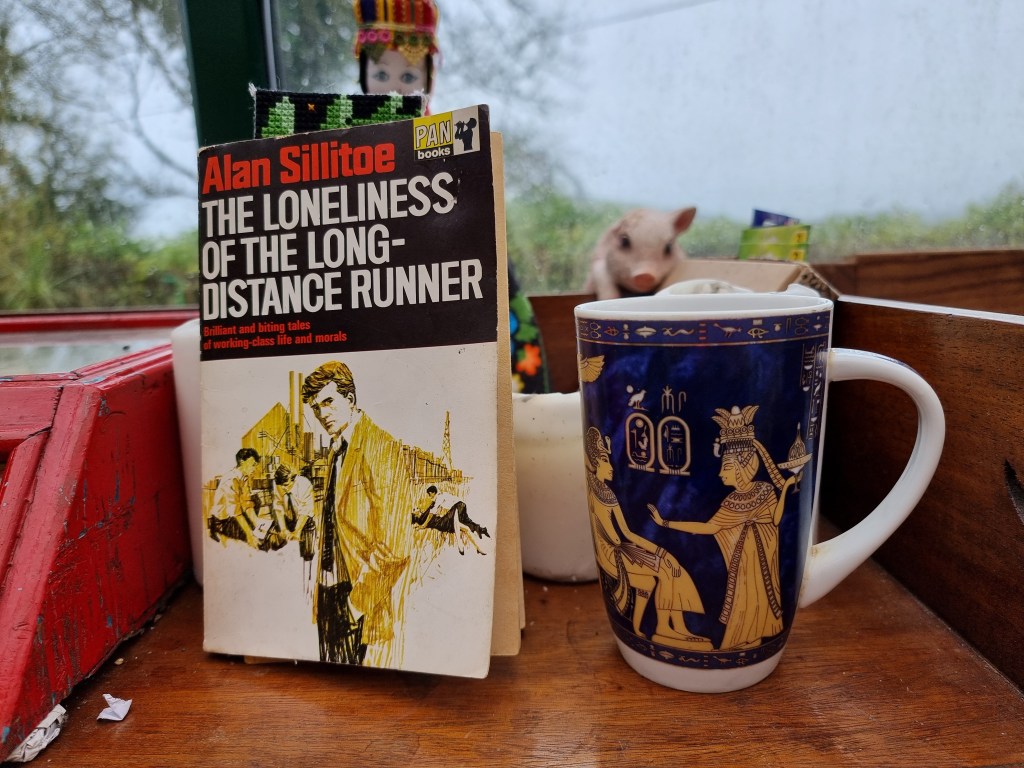
A snarling bulldog charge of a book, this. Gritty short stories about working class men and boys in the bombed-bleak, austere cities of 1950s Britain, struggling for existence in the face of adversity and systemic exclusion. With different furniture it’s sci-fi. Hell, it could be a book about now, only we’ve got different jackets.
Clipped and furious like a gin-induced forecourt drubbing, the author wastes not a word getting across his point: the designed existence of an internecine struggle of class against class which pits man against man. We are warned away from the careless, inhuman architectures of waiting room worlds, whose attritive boredoms and forbidden pleasures set man at unnatural odds with himself. Bet Mark Fisher (RIP) loved this one. Sometimes it feels real, painfully so. Other times it feels soapy and scripted, with that hollow ring of cant which so frustrates a open-book Byron. In this slim and vinegary volume’s wider universe, wasps come with wedding rings, and when promotion sings the hungry fenders of any roads’ drunkest drivers are never far from those recently-laurelled heads.
The titular tale is the collection’s best. A sneering, punky evocation of rubble-dusted industrial hopelessness with a deliciously Saki-esque denouement. It concerns a young convict who, because of his athletic prowess, is extended special liberties of mobility forbidden to other inmates, to better promote curative sporting in a wayward ephebe; ostensibly in order that he would win the prison a trophy come race day, and, by extension, token its hypocritically-pious gaffer with overdue glories. It is on those glassy, eerie-quiet morning runs, during which the jogging juvie alternately imagines himself the first or last man on the Earth, that the unrepentant penned-up runner has time, for the first time in a life spent sprinting, to think everything over.
In another story less successful in the accomplishment of its aims, a feckless child rendered anonymous by his brood’s size, who has been left behind during a family cinema excursion, wanders aimlessly about a housing estate before monitoring a depressed man’s efforts to hang himself. When the attempts of the understudy Pierrepoint inevitably fail, he finds himself carted off to jail for the sin of loathing a loathsome world; the dome of whose borrowed, unowned loam is the lowly rotting of a fruit. Upon reflection, this felt like one of Black Mirror’s less-good later efforts.
In a different tale, a distracted and unsatisfied schoolmaster, occupied more by the cross-street action happening in his classroom’s casement than the Biblical analysis within, has a dust up with his least-applied pupil. In the end it is limply revealed that one of the parade of pretty and nameless ladies whom the tutor has lavished with especial secret attentions, whose breast proportions the author has laboured in overdescribing, was murdered off page by a, like nameless, gentleman caller.
I loved when it felt like Nil by Mouth or the Browning Version but disliked when it felt a bit Bash Street Kids, or the street arab equivalent of the Hitler Diaries. When reading, depending on the type of tale told, my head employed either the “Oi!” voice of Danny Dyer or that of pugilistic embellisher Paul Sykes. I recommend this book and rate it 3/5.
 Alchemisland
Leave a comment